
Introduction
In today’s fast-paced digital world, web applications are expected to be fast, scalable, and capable of handling millions of users simultaneously. Traditional server-side technologies often struggle with performance and scalability when dealing with high traffic and real-time applications. This is where Node.js comes into the picture.
Node.js has revolutionized backend development by allowing developers to use JavaScript on the server side, enabling faster development, better performance, and unified frontend–backend programming. Since its release, Node.js has become one of the most popular technologies for building modern web applications, APIs, microservices, and real-time systems.
This article explains what Node.js is, how it works, why we use it, its advantages, use cases, and limitations, in a clear and detailed manner.
What Is Node.js?
Node.js is an open-source, cross-platform JavaScript runtime environment that allows JavaScript to run outside the browser. It is built on Google Chrome’s V8 JavaScript engine, which compiles JavaScript directly into machine code for high performance.
Before Node.js, JavaScript was mainly used for frontend development—handling UI interactions, form validations, and browser events. Node.js changed this by allowing developers to write server-side code using JavaScript, making JavaScript a full-stack programming language.
Key Characteristics of Node.js
How Node.js Works
To understand why Node.js is powerful, it’s important to understand its internal working.
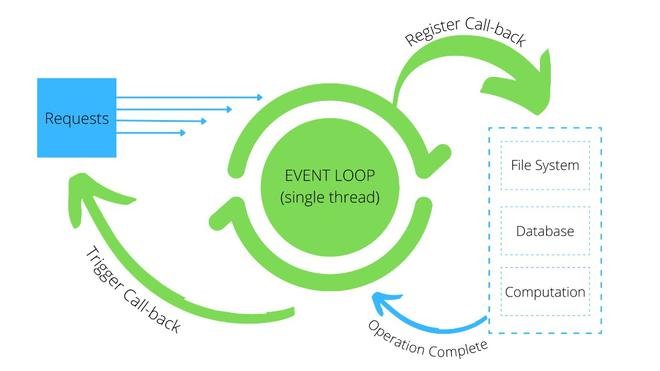
1. Single-Threaded Architecture
Node.js uses a single main thread to handle client requests. Unlike traditional servers that create a new thread for each request, Node.js handles all requests using one thread.
At first, this may sound like a limitation—but this is where Node.js becomes smart.
2. Non-Blocking I/O
Node.js does not wait for tasks like database queries, file reads, or API calls to complete. Instead, it:
- Sends the task to the background
- Continues executing other code
- Executes a callback when the task is completed
This is known as non-blocking or asynchronous I/O.
3. Event Loop
The event loop is the heart of Node.js. It continuously checks:
- Are there pending callbacks?
- Are promises resolved?
- Are timers completed?
When a task is ready, the event loop executes it. This makes Node.js extremely efficient for handling large numbers of concurrent connections
Why Do We Use Node.js?
Node.js is widely used because it solves many problems faced by traditional backend technologies.
1. High Performance
Node.js is fast because:
- It uses the V8 engine
- It avoids blocking operations
- It handles thousands of requests concurrently
This makes it ideal for applications that need low latency and high throughput.
2. JavaScript Everywhere (Full-Stack Development)
With Node.js:
- Frontend → JavaScript
- Backend → JavaScript
- Database handling → JavaScript
This allows:
- Code reusability
- Faster development
- Easier team collaboration
- No need to switch between languages
3. Scalability
Node.js is designed for scalable network applications. Companies can:
- Handle millions of users
- Use microservices architecture
- Easily scale horizontally
This is why many large companies use Node.js for high-traffic platforms.
4. Real-Time Applications
Node.js is perfect for real-time features such as:
- Chat applications
- Live notifications
- Online gaming
- Stock trading dashboards
Technologies like WebSockets work seamlessly with Node.js.
5. Huge Ecosystem (NPM)
Node.js comes with NPM (Node Package Manager), the largest software registry in the world.
Benefits of NPM:
- Thousands of ready-made libraries
- Faster development
- Community-maintained packages
- Easy dependency management
6. Easy to Learn
If you already know JavaScript, learning Node.js is easy. There is no steep learning curve compared to other backend technologies.
Features of Node.js
1. Asynchronous and Event-Driven
All APIs are asynchronous, making Node.js efficient and non-blocking.
2. Fast Execution
V8 engine compiles JavaScript into machine code.
3. Single Programming Language
No need to learn separate backend languages.
4. Cross-Platform
Runs on:
- Windows
- Linux
- macOS
5. Open Source
Free to use and constantly improved by the community.
Use Cases of Node.js
Node.js is used in a wide variety of applications.
1. Web APIs
REST APIs and GraphQL APIs built using Node.js are fast and scalable.
2. Real-Time Chat Applications
Node.js handles multiple users efficiently using WebSockets.
3. Streaming Applications
Node.js can process data in chunks, making it ideal for:
- Video streaming
- Audio streaming
- File uploads
4. Microservices Architecture
Node.js works well for building independent microservices.
5. IoT Applications
Handles multiple device connections efficiently.
6. FinTech and Trading Systems
Used for applications requiring real-time data updates.
Advantages of Node.js
- High performance and speed
- Excellent scalability
- Single language for frontend and backend
- Large ecosystem (NPM)
- Strong community support
- Ideal for real-time applications
Limitations of Node.js
Despite its advantages, Node.js is not perfect.
1. CPU-Intensive Tasks
Node.js is not ideal for heavy computation tasks like:
- Image processing
- Video encoding
- Machine learning (without workers)
2. Callback Hell
Poorly written asynchronous code can become complex (though promises and async/await solve this).
3. Single Thread
A bug or crash can affect the entire application if not handled properly.
Node.js vs Traditional Backend Technologies
| Feature | Node.js | Traditional Servers |
|---|---|---|
| Thread Model | Single-threaded | Multi-threaded |
| I/O Model | Non-blocking | Blocking |
| Performance | High | Moderate |
| Scalability | Excellent | Limited |
| Language | JavaScript | Java, PHP, C# |
Popular Companies Using Node.js
Many top companies use Node.js, including:
- Netflix
- PayPal
- Uber
- Walmart
- eBay
They use Node.js to handle millions of concurrent users efficiently.
Future of Node.js
Node.js continues to evolve with:
- Better performance
- Improved security
- Worker threads
- Native ES module support
With the rise of cloud computing, serverless architecture, and microservices, Node.js remains a future-proof technology.
- Learn more about backend concepts in our guide on
Backend Development Explained - If you are new to JavaScript, read
JavaScript Basics for Beginners